The Great Migration: Your Complete Serengeti Guide
Over 1.5 million wildebeest, 200,000 zebra, and 500,000 gazelle move in an endless circle across the Serengeti. Here is exactly when and where to witness it.
The Great Migration: Your Complete Serengeti Guide
There is no wildlife spectacle on earth quite like it. Over 1.5 million wildebeest, 200,000 zebra, and 500,000 Thomson's gazelle move in a continuous, instinct-driven circle across the Serengeti ecosystem — roughly 1,800 kilometres every year, following the rains and the grass.
People call it the Great Migration. We call it the reason we do what we do.
After more than two decades guiding guests through the Serengeti, our team at Absolute Wilderness has watched this spectacle in every month of the year, in every corner of the park. This is everything you need to know to witness it for yourself.
What Exactly Is the Great Migration?
The Great Migration is not a single event — it is a year-round, circular movement of animals across the Serengeti-Mara ecosystem, which spans northern Tanzania and southern Kenya. The herds follow one simple principle: fresh grass.
The cycle is driven by rainfall patterns. As the short rains arrive in the south and the long rains push the herds north, the animals move with them. They have been doing this for hundreds of thousands of years.
What makes it extraordinary is the sheer scale. When you are standing on the Serengeti plains with wildebeest stretching to every horizon, the sound of hooves and the smell of dust filling the air, you understand why this is considered one of the Seven Natural Wonders of Africa.
Month-by-Month: Where Are the Herds?
January – March: Calving Season in the Southern Serengeti
The herds are in the short-grass plains of the southern Serengeti and the Ndutu area, close to the Ngorongoro Conservation Area border. This is calving season — approximately 500,000 wildebeest calves are born within a six-week window, usually peaking in February.
Why visit now: Calving season is one of the most dramatic wildlife experiences in Africa. Predator activity is intense — lions, cheetahs, hyenas, and wild dogs all converge on the southern plains. The grass is short, visibility is excellent, and the density of wildlife is extraordinary.
April – May: The Long Rains and the Move North
The long rains arrive and the herds begin moving north and west through the central Serengeti. This is the low season — the roads can be muddy and some camps close — but the landscape is lush and green, and the herds are on the move.
Why visit now: Fewer tourists, lower prices, and the dramatic sight of hundreds of thousands of animals streaming across the plains. If you do not mind the occasional muddy track, this is exceptional value.
June – July: The Western Corridor and the Grumeti River
By June, the herds have reached the Western Corridor and face their first major river crossing — the Grumeti River. The crocodiles here are enormous, having waited all year for this moment.
Why visit now: The Grumeti crossings are less famous than the Mara crossings but no less dramatic. The crocodiles in the Grumeti are among the largest in Africa. Camps in the Western Corridor offer exclusive access to this spectacle.
July – October: The Mara River Crossings
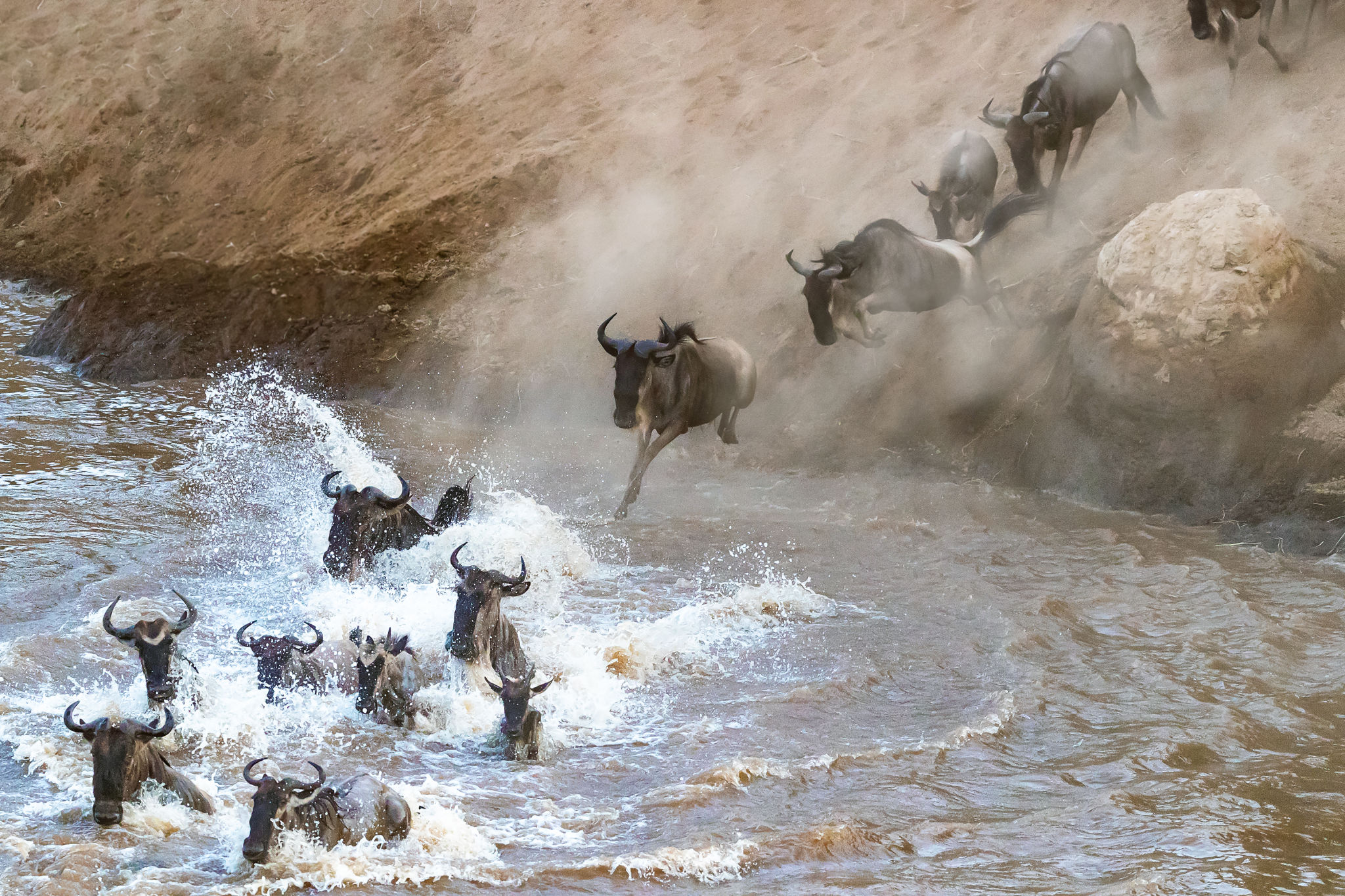
This is what most people picture when they think of the Great Migration. The herds have moved into the northern Serengeti and begin crossing the Mara River into Kenya's Masai Mara — and back again. The crossings are unpredictable, chaotic, and utterly unforgettable.
Why visit now: The Mara River crossings are the most dramatic wildlife event on the planet. Thousands of wildebeest plunge into crocodile-filled water, driven by instinct and momentum. A single crossing can last hours. You may witness multiple crossings in a single day — or wait three days for one. That unpredictability is part of the magic.
Our advice: Stay in the northern Serengeti rather than crossing into Kenya. The Tanzania side of the Mara River offers equally spectacular crossings with far fewer vehicles.
November – December: The Return South
The short rains arrive in November and the herds begin moving south again, back through the central Serengeti toward the southern plains where the cycle began. The landscape turns green almost overnight.
Why visit now: This is a transitional period with excellent wildlife viewing and fewer crowds. The herds are spread across a wide area, and the birdlife is spectacular as migratory species arrive.
The Mara River Crossings: What to Expect
The river crossings are the most sought-after moment of the migration — and the most unpredictable. Here is what our guides want you to know:
You cannot schedule a crossing. The wildebeest decide when to cross based on factors we still do not fully understand. Our guides read the herds — the way they gather at the bank, the nervous energy that builds — and position you in the right place at the right time.
Patience is everything. We have had guests wait two hours and witness three crossings in a single morning. We have also waited three days. Both experiences are equally valid — the anticipation is part of the story.
The crossing itself lasts 20 to 90 minutes. Once the first wildebeest commits, the rest follow in a thundering, desperate surge. Crocodiles strike from below. Wildebeest scramble up the far bank. Some do not make it. It is raw, visceral, and completely humbling.
How to Plan Your Migration Safari
Choose the Right Region for Your Dates
The migration is in a different part of the Serengeti in every month. The most important decision is matching your travel dates to the right region:
- January–March: Southern Serengeti / Ndutu (calving)
- June–July: Western Corridor (Grumeti crossings)
- July–October: Northern Serengeti (Mara crossings)
Stay in a Mobile or Fly Camp
The best way to follow the migration is to stay in a camp that moves with the herds. Our mobile camps in the northern Serengeti are positioned within walking distance of the Mara River during peak crossing season.
Allow Enough Time
We recommend a minimum of four nights in the Serengeti to give yourself the best chance of witnessing a crossing. Seven nights is ideal.
Combine with Ngorongoro and Tarangire
A Tanzania safari is not just the Serengeti. Combining your migration safari with the Ngorongoro Crater — the world's largest intact volcanic caldera, home to the densest population of large mammals in Africa — and Tarangire National Park, famous for its enormous elephant herds, creates an itinerary that covers the full breadth of Tanzania's wildlife.
Frequently Asked Questions
Is the Great Migration only in the Serengeti? The migration moves between the Serengeti in Tanzania and the Masai Mara in Kenya. We recommend staying on the Tanzania side for a more exclusive experience with fewer vehicles.
What is the best month to see the Great Migration? There is no single best month — it depends what you want to see. For river crossings, July to October. For calving and predator action, January to March. For lush landscapes and fewer crowds, April to June.
Can you guarantee a river crossing? No one can guarantee a crossing — and any operator who claims otherwise is not being honest with you. What we can guarantee is that our guides know the Serengeti intimately and will give you the best possible chance.
How far in advance should I book? For peak season (July–October), we recommend booking 12 to 18 months in advance. The best camps fill up quickly.
Plan Your Migration Safari with Absolute Wilderness
Our guides have been watching the Great Migration for over two decades. We know the Serengeti's rhythms, its hidden crossing points, and the subtle signs that tell us when the herds are about to move.
We build bespoke itineraries around your travel dates, your interests, and the migration's current position. No two safaris are the same — because no two migrations are the same.
Contact us to start planning your Great Migration safari. We will take care of everything else.
Explore Topics
Written by
Henry Mejooli, Absolute Wilderness
Content creator and writer sharing insights and stories.